
Kuari Pass Trek
One of Uttarakhand’s Most Scenic Winter Trails
Kuari Pass Trek Trek: Complete Overview
The Kuari Pass trek is a 6-day, moderate-grade Himalayan trek in Uttarakhand. It climbs to roughly 12,516 ft and ends near the ski slopes of Auli. You’ll cover about 22 km of actual walking across four trekking days. Oak forest, high meadows, and a ridge walk with Nanda Devi in full view. This is a first Himalayan trek for most people who do it. Not a warm-up for veterans. You don’t need mountaineering skill. You do need real fitness and a few weeks of prep. This guide covers the route, the cost, and the best month to go.
This isn’t one trek with one fixed distance. It’s one trek with four different starting points. That’s exactly why the numbers you’ll see online don’t agree with each other. Operators start from Karchi, Dhak, Pipalkoti, or Joshimath. Karchi-based packages quote around 21-22 km. Packages routed through Pipalkoti or Joshimath quote 27 km or more. Neither number is wrong. They’re just measuring a different starting line.
The trek climbs to roughly 12,516 ft at its highest point, called Kuari Top. A few sources list 12,750 ft for the technical pass a short distance beyond. Most groups turn around at Kuari Top. The view barely changes past that, and the extra stretch adds real fatigue.
Base camp sits at Karchi or Dhak in the Chamoli district, a short drive from Joshimath. The trek runs six days door to door. Four of those days involve actual walking.
5 Reasons Kuari Pass Trek Stands Apart
Click each reason to read the full story.
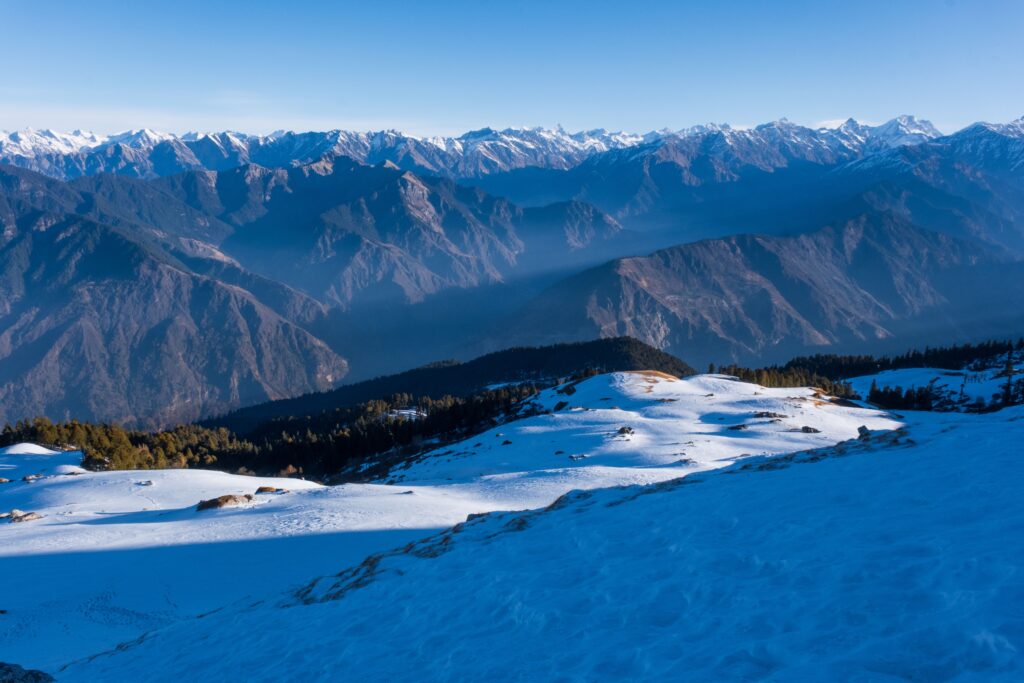
From Gorson Bugyal and the ridge near Kuari Pass, India’s second-highest peak sits close enough that you forget to check your camera settings.
Chaukhamba, Dronagiri, Kamet, and Hathi Ghoda line up alongside Nanda Devi. Few moderate treks in Uttarakhand pack this many peaks into a single view.
Named for the British viceroy who walked this exact ridge in 1905. The history adds real weight to an already scenic stretch.
Oak, maple, and rhododendron close in overhead. Rhododendrons bloom red and pink through March and April, and golden oak leaves carpet the ground by late autumn.
Long grass, wide sky, mountains on three sides. Trekkers coming down from Tali usually name it their favorite stretch of the whole trek.
Kuari Pass Trek: Detailed Day-by-Day Guide
| DAY | ROUTE | DISTANCE | DURATION | ALTITUDE GAIN | ALTITUDE LOSS |
|---|---|---|---|---|---|
| 1 | Haridwar → Joshimath | ~280 km | 9–10 hrs | ~6,500 ft | — |
| 2 | Joshimath → Dhak → Gulling | ~6 km | 4–5 hrs | ~2,000 ft | — |
| 3 | Gulling → Kuari Pass → Tali | ~12 km | 7–8 hrs | ~2,500 ft | ~1,500 ft |
| 4 | Tali → Auli → Joshimath | ~9 km | 5–6 hrs | ~500 ft | ~2,000 ft |
| 5 | Joshimath → Haridwar | ~280 km | 9–10 hrs | — | ~6,500 ft |
Quick stats: Distance: 255 km | Time: 9-10 hrs | Altitude: 6,565 ft
This day is a drive, not a trek. Around 250 km separate Rishikesh from base camp. The road takes 9-10 hours with stops. You’ll pass Devprayag, Rudraprayag, and Karnaprayag. Three of Uttarakhand’s five sacred river confluences, hugging the Alaknanda most of the way. Past Pipalkoti, the landscape shifts fast. Mountains close in. Mt. Dronagiri appears for the first time, a peak that stays visible for most of the trek ahead. Save your energy today. Tomorrow is when the real walking starts.
Quick stats: Distance: 5 km | Altitude: 1,900 ft | Time: 3-4 hrs
Climb starts almost immediately out of camp. The first kilometer runs relatively flat through the village. Then the trail steepens into forest, gaining close to 1,500 ft in under 3 km. Oak, pine, and maple close in overhead. Cones and seed pods scatter the path underfoot. About 20 minutes in, a clearing opens on your left. Your first real look at Karchu village and the glaciers behind it. Locals tell a Hanuman story about that exact mountain. Worth asking your guide about, if you’ve got breath to spare. The trail switchbacks on through forest until a single walnut tree marks Akhrotghetta campsite. It sits beside a stream, with the Hathi Gauri peaks visible above the treeline.
Quick stats: Distance: 4 km | Altitude: 1,200 ft | Time: 3-4 hrs
Take this day slower than day 2’s steepness suggests you should. The climb here is gentler, spread across a longer stretch. Mostly under oak canopy that gradually turns golden the higher you go. Watch for dwarf rhododendrons around the second clearing, about an hour in. Ice forms on stream crossings through winter. Footing gets genuinely tricky there if you’re not careful. Mountains play peekaboo through gaps in the canopy most of the afternoon. Khullara campsite sits in an open clearing near the treeline. It’s the coldest camp on the entire route. Layer up before dinner, not after you’re already shivering.
Quick stats: Altitude: -1,800 ft | Distance: 10 km | Time: 6-7 hrs
This is the day the whole trek builds toward. You climb out of Khullara’s treeline steeply for an hour to ninety minutes. That gets you to a ridge that’s part of the actual Curzon Trail. From there, the Himalayas open up in every direction. Chaukhamba, Neelkanth, Dronagiri, Nilgiri, and Hathi Ghoda on one side. Trishul and Nanda Devi straight ahead. A shrine marks the point where Pangarchulla Peak comes into view. Most groups stop at Kuari Top rather than pushing to the technical pass. The added half hour barely changes the view. It does add real fatigue. From the top, retrace to the ridge, then continue to Jhandi Top before dropping into forest toward Chitrakantha meadow. The final stretch into Tali dives into dense golden oak forest. Quiet enough that you notice the silence before you notice the campsite. Eight to nine hours. Most of it earned honestly.
Quick stats: Distance: 8 km | Altitude: -1,500 ft
Yesterday was climbing and ridge walking. Today is almost entirely descent, with one sharp exception early on. A 30-40 minute climb to Tali Lake gets you back above the treeline. It’s followed by a narrow overhanging trail cut into a cliff face above the Dhak valley. This section demands real attention, especially wet or under snow. Past it, the trail opens into Gorson Bugyal. A wide meadow with Nanda Devi visible from an angle most photos never capture. Cross the meadow, drop through Padiyar’s oak forest, pass a small temple. Descend the final stretch into Auli. Seven to eight hours of walking, then a short drive down to Dhak or Karchi for the night.
Quick stats: Distance: 260 km | Altitude: -7,400 ft
The trek is over. What’s left is the same 250 km drive in reverse. Starting early to reach Rishikesh by evening. Most groups leave by 6 am to beat the worst of the road traffic. Use the ride to actually process what you just did. The trek itself rarely leaves room for that.
How Difficult Is the Kuari Pass Trek: Honest Assessment
“Moderate” sounds like a formality until day one’s climb hits. Two specific sections decide whether this trek feels hard. Neither gets flagged clearly enough on most trek pages.
The first is day 2’s opening climb. Nearly 1,500 ft of gain packed into under 3 km, tackled before your body has any real acclimatization. It’s steep, it’s early, and it sets the tone for how your legs feel the rest of the trip. Pace yourself here specifically. Rushing this section is the single most common reason first-timers struggle later on.
The second is the narrow overhanging trail above Gorson Bugyal on day 5. Cut into a cliff face, with real exposure on one side. In dry, clear weather it’s a straightforward, if narrow, walk. In rain, fog, or snow, it turns genuinely tricky. This is the one stretch where a good guide earns their fee.
Beyond those two sections, the trek stays well within reach for a reasonably fit beginner. Trails are well-marked outside of Gorson Bugyal’s forest entry point, which can be easy to miss in poor visibility.
Altitude is a separate concern from terrain, and the two shouldn’t get confused. You’ll spend day 4 above 12,000 ft. High enough for acute mountain sickness to be a real possibility, regardless of fitness level. Fitness makes the trek easier to walk. It does not make you immune to altitude. Anyone can get hit by AMS above 10,000 ft. Fit or not, first-timer or veteran. Watch for headache, nausea, and unusual fatigue. Tell your trek leader immediately if you notice any of it.
Overall grade: moderate. Genuinely well suited to a first Himalayan trek, provided you respect those two specific sections. “Moderate” is not a label that guarantees nothing can go wrong.
The Kauri Pass Trek has a moderate to challenging terrain with a mix of forest trails, steep climbs, open meadows and rocky sections. The initial trail through oak and rhododendron forests is mostly uneven but manageable. As you gain altitude, the path becomes steeper and more exposed, especially around Khullara and the Kuari Pass section. The approach to the pass can be tiring because of loose rocks, steep slopes and changing weather. Gorson Bugyal offers more open and gradual terrain, but long walking hours can still test your stamina. During winter and early spring, snow can cover the trail and make footing more difficult. Good fitness, proper trekking shoes and steady pacing are important for handling the terrain safely.
| SEASON | DAY TEMPERATURE | NIGHT TEMPERATURE | WEATHER |
|---|---|---|---|
| March – April | 5°C to 15°C | -2°C to 5°C | Cold, with snow on higher sections |
| May – June | 15°C to 24°C | 3°C to 8°C | Pleasant days and cool nights |
| July – August | 14°C to 20°C | 5°C to 12°C | Monsoon, rain and cloudy conditions |
| September – November | 10°C to 18°C | -1°C to 5°C | Cool, dry and clearer mountain views |
| December – February | -5°C to 10°C | -15°C to -3°C | Very cold with snowfall on higher sections |
Temperature varies sharply with altitude on the Kauri Pass Trek. The higher camps around Khullara and the pass can be much colder than Joshimath, especially at night. Weather can also change quickly, so trekkers should carry warm layers and rain protection.
The Kauri Pass Trek reaches around 12,500 ft, so proper acclimatization is important. The trek starts at a lower altitude near Karchi/Dhak (around 7,800 ft) and gains height gradually through Akhrotgetta and Khullara before reaching Kauri Pass. Spending time at intermediate camps helps your body adjust to the lower oxygen levels. Walk at a steady pace, drink enough water and avoid rushing on uphill sections. Mild headache, tiredness or shortness of breath can happen as you gain altitude, but worsening symptoms should not be ignored. If you develop severe headache, vomiting, confusion, difficulty walking or breathing problems at rest, descend immediately and seek medical help. Good fitness helps, but it does not completely prevent altitude sickness.
The Kauri Pass Trek involves steep climbs, uneven trails, high-altitude sections and changing mountain weather. Stay with your trek group, follow the trek leader’s instructions and avoid walking alone. Carry a rain jacket, warm layers, sturdy trekking shoes, a headlamp, personal medicines and basic first-aid supplies. Keep your phone and power bank charged, but do not depend entirely on mobile connectivity in remote sections. If you feel unwell at high altitude, inform the trek leader immediately rather than continuing.
In an emergency, descent is the main evacuation option. From the higher camps and Kauri Pass section, trekkers can be taken back towards Tali, Khullara and Karchi/Dhak, depending on the location and trail conditions. Auli and Joshimath are the main road-access points for further medical assistance. Weather, snow and trail conditions can affect evacuation time, so emergency movement should be managed by the trek team.
Best Time to Do the Kuari Pass Trek: Season by Season
Winter and autumn give you the same mountains in two completely different moods. Which one you pick should match what you actually want from the trip. Not just which month happens to be free on your calendar.
Buries the trail under snow from December onward. It turns the route into close to a beginner’s snow-trekking course. Daytime temperatures hover between 8°C and 14°C. They drop to -8°C or colder overnight. Khullara gets brutally cold this time of year, colder than most other treks running the same season. You’ll need microspikes, gaiters, and real cold-weather gear. Verdict: pick winter if snow and stark, quiet landscapes matter more to you than comfort.
Catches the transition. Snow recedes from lower camps. The upper reaches around Khullara and Chitrakantha often stay under snow until mid-April. Rhododendrons bloom red through the forest sections during this window. You get snow, green grass, and flowers all in one frame. A contrast that doesn’t last long. Verdict: pick spring for that specific mix, and expect uneven footing as snow melts across the route.
Brings the mildest days of the year. 18-24°C by day, cooler nights around 3-8°C. This is the easiest season on your body. Visibility can soften by late June, though, as pre-monsoon cloud starts building most afternoons. Verdict: pick summer if easy conditions matter more to you than crisp, sharp mountain views.
Delivers the clearest air of the year. Right after the monsoon washes the dust out of the sky. Meadows turn golden brown. Days stay sunny, and peak visibility is about as good as this trek gets. Nights get cold fast as you head toward November. Verdict: pick autumn if photography and sharp, unbroken mountain views top your list.
July and August are closed. Not discouraged, not “less ideal.” Genuinely closed. Monsoon rain makes several sections unsafe, and most operators won’t run batches through those two months at all. Don’t plan around them.
For the 2026-27 season, expect the trek to open again from September. It runs through June, with the usual monsoon gap in between.
How to Reach Kuari Pass Trek: Complete Travel Guide
Get to Rishikesh first. Everything else on this trek starts from there, whichever exact base point your operator uses.
By air: Jolly Grant Airport in Dehradun is the closest airport, about an hour from Rishikesh by road. Flights connect through Delhi most days. From the airport, a taxi or bus covers the last stretch into Rishikesh.
By train: Haridwar is the nearest major railhead, roughly 30 km from Rishikesh. Well connected to Delhi and other major cities. A short taxi or bus ride finishes the journey from there.
By road: Direct buses and overnight sleeper services run from Delhi to Rishikesh. From Rishikesh, a private taxi or your operator’s transport covers the remaining 250 km to base camp. Budget a full day for this stretch alone.
That last 250 km matters more than people expect. If your package says “Pipalkoti to Pipalkoti,” you’re driving further than a “Karchi to Karchi” package covers. That gap is exactly why pickup times and quoted costs vary so much between operators. Confirm which base point your package actually uses before you book. It changes both your travel time and your total cost.
Arrive in Rishikesh the day before your trek starts, not the same morning. Pickup times run early, usually 5:30-6 am. A buffer day protects you against delayed flights or trains. It also gives you a chance to rest before 9-10 hours on mountain roads.
Arranging your own transport instead of using operator pickup? Shared jeeps run from Joshimath to Karchi for around ₹100 per person. A private cab over the same 17 km stretch runs roughly ₹700.
From Delhi, travel by train, bus or flight to Rishikesh. Several trains and buses connect Delhi with Rishikesh. From Rishikesh, take a road transfer towards Joshimath and Karchi/Dhak, the trek’s starting point. The complete journey from Delhi to the trek base usually takes about 10–12 hours by road.
From Mumbai, the easiest option is to fly to Dehradun Airport or Delhi. From Dehradun, travel by road to Rishikesh and then continue towards Joshimath and Karchi/Dhak. From Mumbai, plan around a full day for travel to reach the trek’s starting point comfortably.
From Bangalore, take a flight to Dehradun Airport (Jolly Grant Airport) or Delhi. From Dehradun, continue by road to Rishikesh, then travel towards Joshimath and Karchi/Dhak. If flying to Delhi, you can continue by overnight train or bus to Rishikesh before starting the road journey.
After completing the Kauri Pass Trek, plan your return journey with some extra time because mountain roads can be affected by traffic, weather and road conditions. From Auli, travel to Joshimath and then continue towards Rishikesh. If you have a train or flight from Delhi or Dehradun, keep at least a few hours of buffer rather than booking a tight connection. Carry snacks and water for the long road journey, and keep your travel documents and valuables easily accessible. If travelling during the monsoon or winter, check road conditions before leaving. It is also better to avoid scheduling an important flight or train on the same day if possible.
Before the trek: Stay in Rishikesh if your trek transfer starts from there. It gives you easy access to transport and lets you arrive a day early without rushing. If your itinerary requires reaching the trailhead earlier, Joshimath is another practical overnight stop before heading towards Karchi/Dhak.
After the trek: Stay in Auli or Joshimath after completing the trek. Auli is useful if you want a quiet mountain stay, while Joshimath has more accommodation and transport options. If you are travelling back to Delhi or catching a flight from Dehradun, you can continue to Rishikesh and stay there overnight before your onward journey.
What the Kuari Pass Trek Experience Is Like: Camps, Food, Stay
The Kuari Pass Trek combines forest walks, open meadows, steep climbs and high-altitude trails. You pass through peaceful Himalayan landscapes before reaching the pass, where wide mountain views open up. The trek feels rewarding without being rushed, with changing terrain, quiet camps and memorable views throughout the journey.
There are no permanent hotels or lodges at Kauri Pass. During the trek, accommodation is usually provided in tents at designated campsites such as Akhrotgetta, Khullara and Tali. Trekkers generally stay in shared tents with sleeping bags and mattresses provided by the trekking operator. Facilities are basic, with temporary toilet arrangements and limited access to electricity. At Joshimath or Auli, you can find hotels and guesthouses before or after the trek.
Food on the Kauri Pass Trek is usually simple, warm and filling, with meals planned to provide enough energy for long walking days. Breakfast can include poha, upma, paratha, eggs or porridge, while lunch may include rice, dal, roti, vegetables and salad. Evening tea, snacks and a hot dinner are generally served at camp. Carry personal snacks such as dry fruits, energy bars and chocolates for extra energy on the trail. Vegetarian meals are commonly provided, while food options can be limited at remote camps.
Hygiene facilities on the Kauri Pass Trek are basic because the trail passes through remote mountain areas. Camps usually have temporary toilet tents or designated toilet areas. Proper bathing facilities are generally not available at the higher camps, so carry wet wipes, biodegradable soap, hand sanitiser and a small towel. Use only designated toilet areas and avoid contaminating water sources. Keep personal waste with you until it can be disposed of properly. At hotels in Rishikesh, Joshimath or Auli, you can expect regular toilets, bathrooms and better hygiene facilities before or after the trek.
- 6:00–7:00 AM: Wake up and freshen up at the campsite.
- 7:00–8:00 AM: Have a hot breakfast and attend the morning trek briefing.
- 8:00–9:00 AM: Pack your day bag and begin trekking.
- Morning: Walk through forests, meadows and mountain trails with short water breaks.
- 12:00–1:00 PM: Stop for lunch, either at camp or at a suitable point on the trail.
- Afternoon: Continue towards the day’s campsite, with regular breaks on steep sections.
- 3:00–5:00 PM: Reach camp, relax and enjoy the surrounding mountain views.
- 5:00–6:00 PM: Have tea or snacks and spend some time resting.
- 7:00–8:00 PM: Have dinner and prepare your backpack for the next day.
- 9:00 PM onwards: Rest in your tent and get enough sleep for the next day’s trek.
Kuari Pass Trek Packing List: What to Carry
Most first-timers underpack for one specific campsite, not the whole trek. That campsite is Khullara, confirmed across multiple sources as the coldest camp on this route. Thin layering catches people out hardest right there.
Clothing: The Layering System
Layering on the Kedarkantha route works because it traps warm air in thin pockets between fabrics. One thick jacket cannot do what three thin layers can. You add layers when cold, strip layers when warm. That flexibility is the point.
Layering
- Thermal base layer, top and bottom
- Fleece jacket and a down or insulated jacket
- Waterproof outer shell
- Woolen cap, gloves (both woolen and waterproof), and a balaclava
- 3-4 pairs of warm socks
Footwear
- Waterproof trekking shoes with ankle support, broken in before the trek, not on day 1
- Camp shoes or sandals for evenings
- Microspikes and gaiters if trekking in winter.
Gear
- 50-60 liter backpack with a rain cover, plus a smaller daypack if offloading
- Trekking poles, a headlamp with spare batteries, and UV-protected sunglasses
- Sunscreen, SPF 50 or higher, since altitude sun burns fast even on cloudy days
Personal Essentials
- Water bottle or thermos, energy bars, and a small personal first-aid kit
- Toilet paper and hand sanitizer, since campsite toilets are bio-toilets, not flush facilities
- ID proof, cash (no ATMs past Joshimath), and a power bank
Batteries drain fast in cold temperatures. Keep spares inside your sleeping bag overnight, not in an outer pocket. They’ll actually work the next morning.
What NOT to Carry
Heavy jeans or cotton clothing. Cotton absorbs sweat and refuses to dry at altitude. This is how hypothermia starts. More than 8 to 9 kg total backpack weight. If your bag is heavier, use our offloading service. Carry a daypack with water, snacks, sunscreen, rain cover, and a warm layer. Leave the rest.
How to Get Fit for the Kuari Pass Trek
Fitness decides this trek more than gear does. A reasonably fit beginner in decent shoes will outperform a poorly conditioned trekker carrying premium equipment, every time.
Most operators want to see you run or brisk-walk 5 km in under 35 minutes before they’ll clear you for this trek. That’s not an arbitrary number. It roughly matches the sustained cardio demand of day 4’s summit push, the hardest single stretch on the route. Can’t hit that pace comfortably yet? You have time to build toward it before booking.
Why running specifically, rather than gym cardio alone? Running trains the same muscles you’ll use on uneven terrain. It also trains you for the sudden twists and footing changes a treadmill never demands.
Most operators ask for proof. Usually a few screenshots from a running app like Strava, uploaded two to three weeks before your trek date. Skip this step and you can technically still trek. But a trek leader who sees you struggling has the right to send you back partway through. Do the training. It’s cheaper than a wasted trip.
The Fitness Benchmark
Run this test tomorrow. If you pass all three, you are ready for the Kedarkantha trail.
If you cannot clear these right now, you have 6 weeks. That is enough. Follow the plan below.
Week 1–2: Build Basic Stamina
Start with easy workouts that help your body get used to regular activity. Walk for 30–40 minutes on five days each week and add 15–20 minutes of light jogging on two or three days if you are comfortable. Include basic exercises such as squats, lunges, step-ups, calf raises and planks twice a week. On weekends, take a longer 60–90-minute walk on an incline or uneven surface.
Week 3–4: Increase Strength and Endurance
Now increase the duration and intensity of your workouts. Aim for 45–60 minutes of brisk walking or jogging on most days and add stair climbing for 15–25 minutes twice a week. Increase your strength exercises to three sets, focusing on squats, lunges, step-ups and calf raises. Include one longer weekend walk of around 2–3 hours to prepare your legs for sustained trekking.
Week 5–6: Trek-Specific Training
The final two weeks should focus on longer climbs and carrying a light backpack. Walk or hike for 60–90 minutes on most training days and include stairs or uphill walking twice a week. Plan one longer hike of 3–5 hours each weekend while gradually adding some weight to your backpack. During Week 6, reduce the workout load during the final few days so your body is rested before the trek.
If you start the Kauri Pass Trek without enough fitness, long walking hours and steep climbs can feel much harder than expected. Your legs may tire quickly, and you may struggle to maintain a steady pace. Poor fitness can also make recovery between trekking days slower.
Early fatigue: You may feel exhausted after a few hours of walking.
Breathlessness: Uphill sections can leave you short of breath more quickly.
Muscle soreness: Your legs may become sore after repeated climbs and descents.
Slower pace: You may need more frequent and longer breaks.
Poor recovery: Your body may not recover fully before the next day’s trek.
Difficulty carrying a backpack: Even a light pack can feel heavy over long distances.
Higher risk of slips: Fatigue can reduce balance and concentration on uneven trails.
Altitude problems: Fitness does not prevent altitude sickness, but being tired or dehydrated can make the trek harder to manage.
Building stamina and leg strength before the trek helps you handle the terrain more comfortably and safely.
The Kauri Pass Trek involves long walking days, steep climbs and high-altitude sections, so some trekkers need extra preparation. Trekkers aged 55 and above should assess their fitness carefully and consider a medical check-up before planning the trek, especially if they are not used to regular hiking. Children should only participate if they have suitable fitness, previous hiking experience and can comfortably manage long walking days. For anyone with a medical condition, recent injury or regular medication, speak with a qualified doctor before the trek. Do not hide health concerns from the trek leader. The trek team should know about relevant allergies, medications and emergency contacts before departure. Fitness requirements and age limits can also vary between trekking operators, so check the operator’s current rules before booking.
Kuari Pass Trek Cost: Complete Pricing Breakdown
No ranges. No “starting from” estimates. Here is the exact cost.
| COST COMPONENT | APPROX. COST | WHAT IT COVERS |
|---|---|---|
| Trek Package | ₹7,500 – ₹15,000 | Camping, meals, trek leader, support staff and permits |
| Transport | ₹1,500 – ₹3,500 | Rishikesh/Haridwar to the trek base and return |
| Accommodation | ₹800 – ₹2,500 | Hotel or guesthouse before/after the trek |
| Gear Rental | ₹500 – ₹2,500 | Jacket, trekking poles, shoes or other equipment |
| Personal Expenses | ₹500 – ₹1,500 | Snacks, drinks and other small expenses |
| Estimated Total | ₹12,800 – ₹25,000 | Approximate overall budget per person |
Total minimum cost: Rs 7,850 per person (trek fee only). Offloading and cloakroom are optional.
What Is Included
- All meals from Day 1 dinner through the last day on the trail, freshly cooked and vegetarian
- Camping accommodation at trek sites (twin-sharing tents), plus guest house or hotel stay on Day 1 and the final night
- Trek leader, local guides, and kitchen/support staff for the full trek
- Core camping gear: tents, sleeping bags, and sleeping mats
- Forest permits and entry fees for the Nanda Devi Biosphere Reserve
- Basic safety equipment: first aid kits, oxygen cylinders, and emergency medical support at camp.
What Is Not Included
- Transport to and from Rishikesh, unless your package specifically states it’s included
- Personal trekking gear: jackets, shoes, and backpacks (most operators rent these out separately)
- Backpack offloading, typically ₹1,500-1,600 extra if you want a mule or porter to carry your bag
- Meals eaten during the road journey on Day 1 and Day 6
- Medical or fitness certificates, where required, and any doctor’s visit that comes with them
- Personal spending: snacks, phone charges, tips, laundry
- Costs from emergency evacuation, or from trip delays caused by weather, landslides, or roadblocks
The advertised trek price may not cover every expense. A realistic budget should include small costs before, during and after the trek. These expenses can add up, especially if you are travelling from another city.
- Travel to Rishikesh: Train, bus or flight costs from your city are usually separate.
- Hotel stay: You may need a night in Rishikesh before or after the trek.
- Local transport: Shared taxis or transfers between Rishikesh, Joshimath and Karchi/Dhak may cost extra.
- Trekking gear: Shoes, jackets, backpacks, trekking poles and other equipment may need to be rented or purchased.
- Personal snacks: Energy bars, dry fruits, chocolates and drinks are extra.
- Porter or mule charges: Additional support for carrying personal luggage may cost extra if not included.
- Tips: Some trekkers choose to tip trek leaders, guides, cooks or support staff.
- Emergency expenses: Keep a small reserve for unexpected transport, medical help or route changes.
- Travel insurance: If not included in the package, insurance is an additional cost.
- ATM/cash needs: Remote areas may have limited payment options, so carry enough cash for small expenses.
The cost of the Kauri Pass Trek covers more than just the walk. A well-organised trek needs trained staff, safe camps, food, transport support and the right equipment. We keep these essentials in the package so you can focus on the trail instead of managing every small detail yourself.
- Experienced trek leaders: Trained staff guide you through changing terrain and weather.
- Camping arrangements: Tents, sleeping equipment and campsite support are included as per the package.
- Nutritious meals: Fresh, warm meals help you maintain energy during long trekking days.
- Support staff: Cooks, guides and other ground staff help keep the trek organised.
- Permits and local charges: Required permissions and applicable local fees are covered where mentioned in the package.
- Safety support: First-aid supplies and basic emergency support are arranged for the group.
- Transport: Transfers included in your package reduce the need to arrange local travel yourself.
- Responsible trekking: Proper waste management and responsible campsite practices add to the operating cost but help protect the trail.
| CANCELLATION TIMELINE | CANCELLATION CHARGE | REFUND |
|---|---|---|
| 30 days or more before the trek | 10% of trek cost | 90% refund |
| 15–29 days before the trek | 25% of trek cost | 75% refund |
| 7–14 days before the trek | 50% of trek cost | 50% refund |
| Less than 7 days before the trek | 75% of trek cost | 25% refund |
| 48 hours or less before the trek | 100% of trek cost | No refund |
| No-show or trek started | 100% of trek cost | No refund |
- Follow the trek leader’s instructions at all times.
- Stay with the group and do not walk alone.
- Wear proper trekking shoes with good grip.
- Carry warm clothes and rain protection.
- Drink enough water throughout the trek.
- Walk slowly on steep and uneven sections.
- Do not take shortcuts or leave the marked trail.
- Inform the trek leader if you feel unwell.
- Take altitude sickness symptoms seriously and descend if advised.
- Avoid alcohol and smoking during the trek.
- Keep your personal medicines with you.
- Carry a headlamp, power bank and basic first-aid items.
- Do not litter or damage the natural surroundings.
- Weather can change quickly, so follow any route or schedule changes.
- Keep emergency contact details and a valid ID with you.
Pipalkoti to Pipalkoti
(Transportation Not Included)
Upcoming Batches
Kuari Pass Trek Trek: Frequently Asked Questions
Is the Kuari Pass trek difficult for a first-timer?
It’s graded moderate, and it’s genuinely a strong first Himalayan trek choice. Two specific sections need real attention: day 2’s opening climb, and the narrow trail above Gorson Bugyal. Everything else stays well within reach for a reasonably fit beginner.
Is it safe to trek Kuari Pass solo?
Yes, though it’s not the easiest solo trek to arrange. Independent trekkers handle their own forest permit, and usually a local guide for overnight camping. Guided groups remove that friction entirely if solo logistics sound like too much hassle.
What's the actual altitude of Kuari Pass?
Around 12,516 ft at Kuari Top, where most groups turn around. A few sources list 12,750 ft for the technical pass slightly beyond that point, reached by fewer trekkers.
Is there mobile network on the trail?
Barely. You’ll get intermittent signal on day 1 and day 6 near base camp. Reliable Jio or BSNL coverage at Karchi itself in good weather. Expect no signal at all on days 2 through 5.
What's the best month to do this trek?
Depends on what you want. Autumn (September to mid-November) gives the clearest views. Winter (December to February) gives snow. Spring (March-April) gives a mix of both. Avoid July and August entirely, since the trek is closed for monsoon.
Does this trek suit families with kids?
Children under 14 usually don’t need a formal fitness clearance. Most operators still expect them to be genuinely active and prepared. Check your specific operator’s minimum age policy before booking, since these vary.
Is a permit required for this trek?
Yes, since the route runs through the Nanda Devi Biosphere Reserve. Operators handle this automatically for guided trekkers. Independent trekkers arrange it themselves at the Joshimath Forest Office.
How much does the Kuari Pass trek actually cost?
Typically ₹7,000 to ₹15,000 per person for a guided trek in 2026. It depends mainly on your starting point, group size, and whether insurance and offloading come bundled in. See the cost section above for the full breakdown.
Is prior Himalayan trekking experience required for this trek?
No. This is specifically the kind of trek people choose as their first one. Fitness matters more than prior experience here. Focus your prep on the 5 km cardio benchmark rather than worrying about technical skill you don’t have yet.
Is backpack offloading available on this trek?
Yes. Most operators offer it for roughly ₹1,500-1,600, carried by mule or porter. You’ll still need a small daypack for water, snacks, and any layers you might need during the day.
What should you pack that most lists miss?
Extra warm layers specifically for Khullara campsite, the coldest camp on the route by a real margin. See the full packing list above for everything else.
Treks Similar to Kedarkantha: What to Do Next
Brahmatal Trek
Brahmatal’s summit sits at 12,250 feet, just 250 feet lower than Kedarkantha. The trekking distance is longer at 22 km across 4 trekking days. The trail passes two frozen lakes instead of one. The mountain views are different: Trishul and Nanda Ghunti dominate the skyline instead of Swargarohini and Bandarpoonch. If you loved the snow and summit experience on the Kedarkantha trail and want a similar challenge with new scenery, Brahmatal is the natural next step. Best done in January or February.
Har Ki Dun
Har Ki Dun runs 7 days and covers 45 km through the same national park. Both treks start from Sankri. The difficulty is comparable, but the longer duration tests endurance more than altitude. The route follows the Supin River through ancient Garhwali villages. Swargarohini appears up close from the valley floor. If you want to go deeper into the same mountain range, this is the trek.
Dayara Bugyal
Dayara Bugyal is a high-altitude meadow trek that peaks at around 11,800 feet. The gradient is gentler than Kedarkantha. The meadows are wider. No steep summit push. If you are trekking with children under 8 or family members who prefer rolling green terrain over snow and summits, Dayara Bugyal is the safer introduction.
Deoriatal Chandrashila
Deoriatal Chandrashila combines a lake, a temple (Tungnath), and a summit (Chandrashila, 13,123 ft). The trek is 6 days and mixes cultural stops with mountain trail. If you want more variety in terrain and experience types than Kedarkantha offers, this trek delivers that range.
Further Reading on the Kedarkantha Trek
How We Started Running the Kedarkantha Trek from Sankri — by our founder. The origin story of our Sankri operations, why we chose this route, and what we learned in the first three seasons.
Kedarkantha Trek in January: A Complete Month Guide — by Sneha, who trekked with us in January 2026. Trail conditions, crowd levels, and what surprised her about deep winter on this route.
What Our Youngest Trekker Taught Us About the Kedarkantha Trail — by trek leader Vikram. The story of Aarav Kapoor, age 10, and how his pace changed how we think about family batches.
Kedarkantha vs Brahmatal: Which Winter Trek Should You Do First? — A head-to-head comparison by a trekker who did both in the same season.
The Season-Wise Kedarkantha Packing Guide — with month-by-month clothing recommendations and a downloadable checklist.
