What Makes These Gardens Different from Any Other Historic Garden in India
Most garden guides describe what these gardens look like. None explain how they actually work — and that is the part worth understanding before you visit. Every Mughal garden in Kashmir is a working water machine. The Zabarwan mountains feed natural springs at the highest terrace of each garden. Gravity pulls the water down through the levels — it fills the pools, runs the fountains, then drains into Dal Lake at the base.
Not decoration. Engineering. Built 400 years ago and still functioning today. The charbagh layout is the Persian garden plan, dividing space into four quadrants along a central water axis. It was adapted here for a hill-and-lake terrain that Delhi and Agra could not offer. Walk to the top terrace of Nishat Bagh and look down the central canal toward the lake. That view is the whole design made visible.
Best Time to Visit Mughal Gardens Kashmir (Season and Time of Day)
The season answer is easy. The time-of-day answer is what every guide skips.
The visitor calendar in 2026 follows the same pattern: April for spring blooms, October for Chinar colour. April is the right call for Nishat Bagh — the tulips and irises are in flower. The Chinar trees have not yet filled out and the lake views from the upper terraces are still wide and clear. By June the canopy is dense. Those views are gone. October brings the colour shift. The terraces at Nishat and Shalimar go red and gold. The afternoon light between 4 and 5 PM sits low and sharp. That is the best photography window in either garden.
The time-of-day layer matters for a practical visit. Arrive at Nishat Bagh at 9 AM when the gates open. Tour groups come from 10:30 onwards and the fountain spots fill fast. Shalimar Bagh gets crowded after 11 AM on weekends. Go on a weekday if you can. Chashme Shahi is best in the late afternoon when the low sun hits the terraces directly. The 5 to 7 PM window across all gardens is the emptiest part of the day. Most visitors leave by 5:30. The gardens are open until 7 PM. That last 90 minutes belongs to you.
Kashmir in summer, June through August, is the high season across the valley. The gardens are busy and hot by midday — not the worst time to visit, just not the best. Winter is not the garden season — most gardens stay open but the flowers are gone. Fountains may be reduced and Chashme Shahi has limited winter hours. Go in spring or autumn for the best views.
Season | What you get | Crowd level | Best for |
Spring (Apr to May) | Tulips, irises, open lake views | Moderate | First-time visitors, photographers |
Summer (Jun to Aug) | Full green canopy, dense foliage | High | Families, school holidays |
Autumn (Sep to Nov) | Chinar colour, sharp light | Low to moderate | Photography, couples, repeat visitors |
Winter (Dec to Mar) | Bare trees, quiet | Low | Off-season walkers, budget travel |
The Mughal Gardens Kashmir Visitor Map: Which to Visit and in What Order
Nishat Bagh, Shalimar Bagh, Chashme Shahi, and Pari Mahal all cluster within 8 km of each other — all on or above the eastern shore of Dal Lake. The route that avoids doubling back: Nishat Bagh at 9 AM (1.5 hours). Drive 3 km north to Shalimar Bagh (1 hour). Drive 8 km south to Chashme Shahi (45 minutes). Walk 5 minutes uphill to Pari Mahal (45 minutes). Done by 2:30 PM. Time for lunch before the afternoon light returns.
Naseem Bagh is a different trip. It sits on the western shore of Dal Lake near the University of Kashmir, not the eastern shore. Do not fit it into the route above. It works as a standalone morning walk on a separate day. Achabal and Verinag are not Srinagar day-trip gardens. Achabal is 58 km south in Anantnag district. Verinag is 80 km out. Both are worth a dedicated half-day if you have the time. Do the city gardens first always.
Garden | Distance from Dal Lake Boulevard | Time needed | Best paired with |
Nishat Bagh | 8 km south | 1.5 hours | Start of eastern shore route |
Shalimar Bagh | 11 km north | 1 hour | Nishat Bagh same morning |
Chashme Shahi | 8 km southeast | 45 minutes | Pari Mahal same afternoon |
Pari Mahal | 9 km southeast | 45 minutes | Chashme Shahi, 5-min walk uphill |
Garden by Garden: What Each One Is Actually Like
1. Nishat Bagh
Walk all 12 terraces and that is the one instruction that matters at Nishat Bagh. Most visitors enter, photograph the central fountain on the lower terraces, and leave. The upper terraces have the best views of Dal Lake and are shaded by old Chinar trees. Almost always empty, in October, the canopy on the upper levels turns deep red. The lake below goes silver in the afternoon light and that is the best view in the garden. Most people miss it because they turn back at terrace four.
Nishat Bagh was built in 1633 by Asaf Khan, the brother of Nur Jahan. Second-largest Mughal garden in Kashmir and built across 40 acres. The central canal runs from the mountain spring at the top down to the lake at the base. There are fruit orchards on the upper terraces, apricots and apples, which most guides do not mention. Entry: Rs.20 for Indian nationals. Opens at 9 AM. Allow 1.5 hours minimum.
2. Shalimar Bagh
Nishat Bagh is intimate and vertical while Shalimar Bagh is wide and formal. That is the key difference. It explains why some visitors prefer one and some prefer the other. Shalimar Bagh was built by Emperor Jahangir in 1619 as a royal summer court. Built for his wife Nur Jahan. The garden has three terraces dividing public, courtly, and royal zones. The central canal runs its full length with 410 fountains. The black marble pavilion in the upper Zenana terrace was added by Shah Jahan.
Most visitors walk past it. They do not know what it is. Stand at the upper terrace and look down the canal toward the lake. The whole garden was designed to be seen from that angle. Looking up from the entrance gives you a fraction of the view. Shalimar suits visitors who want open space and scale. Nishat suits visitors who want terraced levels and lake views from every tier. Sound like a fine distinction? It is not. The two gardens feel nothing alike on the ground.
3. Chashme Shahi
Chashme Shahi is the smallest of the three and it is also the most different. The lakeside gardens are flat-terrain adaptations of the charbagh plan. Chashme Shahi is built on a steep hillside around a natural mountain spring. Only 1.7 acres, about one-fortieth the size of Nishat Bagh. Most visitors spend 30 to 40 minutes here. The spring water flows through the terraces and out at the base. Locals and many visitors drink it directly from the flow. It has been described as having medicinal properties for centuries. No current official testing data is publicly available. Drink at your own judgement. What the garden has that the lakeside gardens do not: elevation. The views of Dal Lake from the terraces here are wider and higher than at Nishat or Shalimar. Built in 1632 by Ali Mardan Khan, commissioned by Shah Jahan for his son Dara Shikoh.
4. Pari Mahal
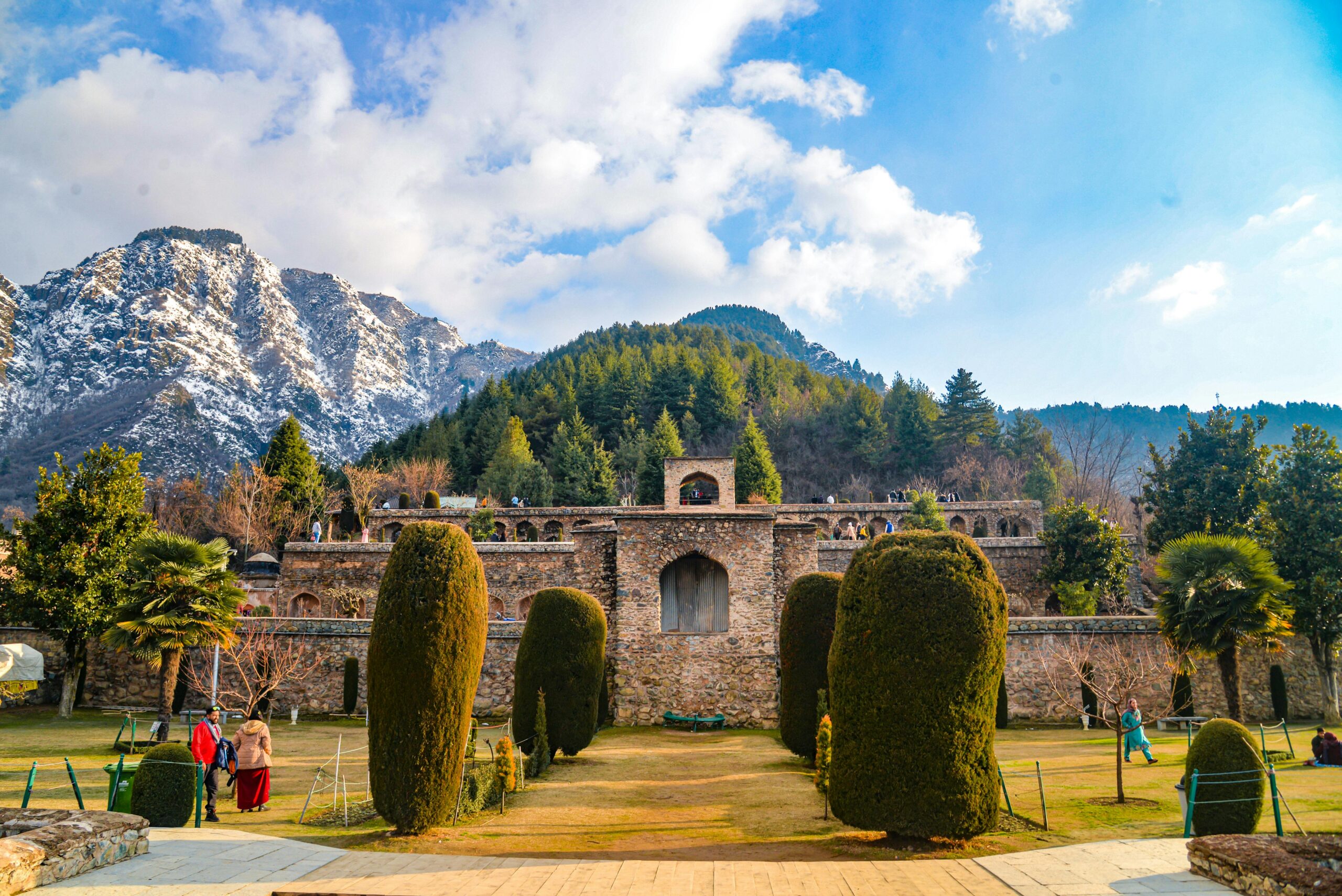
Pari Mahal is the garden most worth visiting and the one most people skip, remember that. It sits 5 minutes on foot above Chashme Shahi. Most visitors to Chashme Shahi either do not know Pari Mahal exists or skip the short climb. Real loss. The seven-terrace ruin looks out over all of Srinagar and Dal Lake. Highest point of any garden on this list. Prince Dara Shikoh built it around 1650 as an astronomical observatory and school for Sufi learning. The result is a garden that feels nothing like the others. More fort-like. More exposed. Less manicured. The arches and stone walls make it feel like a place where serious things happened. Entry is free. Sunset from the top terrace is the best free view in Srinagar. Go there.
These four gardens sit among the wider collection of monuments of Kashmir worth exploring across the valley — many of which are just as overlooked as Pari Mahal.
The Hidden Gardens: Naseem Bagh, Verinag, and Achabal
5. Naseem Bagh
Naseem Bagh is the most practical of the three and it is free, on the western shore of Dal Lake near the University of Kashmir and almost empty. Akbar built it in the 1580s and planted row after row of Chinar trees. Those trees are now among the oldest Chinar plantings in any Mughal garden in the region. In October they go deep gold, the garden fills with a quality of light the eastern-shore gardens cannot match. The trees here are older and taller. Go on a weekday morning in October and there are no manicured flower beds. None at all. What is there is 400 years of Chinar trees and near-complete quiet.
6. Verinag & Achabal
Verinag is 80 km from Srinagar near Anantnag. Built around the octagonal spring that is the source of the Jhelum River. Achabal is 58 km out, built by Nur Jahan in 1620 with a large cascade as its centrepiece. Both are genuine Mughal gardens with real historical value. Both are also long drives on mountain roads. If you have a dedicated half-day and a car, either is worth the trip. If you have a 7-day Kashmir itinerary and the city gardens still on your list, do those first.
Entry Fee, Timings, and Practical Visitor Information (2026)
All the gardens open by 9 AM. Entry fees are low. Here is the full breakdown for 2026. In 2026, entry fees for the main mughal gardens srinagar are low. Nishat Bagh, Shalimar Bagh, and Chashme Shahi each charge Rs.20 per person for Indian nationals. Foreign nationals pay Rs.300. Pari Mahal and Naseem Bagh are free, open seven days a week including public holidays. The 5 to 7 PM window is the most underused visiting slot. Gardens are emptiest then. Light is best for photography. Carry water and there are no reliable food stalls inside the main gardens.
One practical note on getting there. Shared autos run along the Boulevard Road on the eastern shore, stopping at Nishat Bagh and Shalimar Bagh. A few rupees per seat. Chashme Shahi and Pari Mahal sit above the main road. They need a cab or taxi from the Boulevard. Budget Rs.300 to Rs.500 for a cab from Nishat Bagh to Chashme Shahi. Worth every rupee.
Nishat Bagh | Rs.20 | Rs.300 | 9 AM to 7 PM | Largest; allow 1.5 hrs |
Shalimar Bagh | Rs.20 | Rs.300 | 9 AM to 7 PM | Busiest on weekends |
Chashme Shahi | Rs.20 | Rs.300 | 9 AM to 7 PM | Pair with Pari Mahal |
Pari Mahal | Free | Free | 9:30 AM to 7:30 PM | 5-min walk above Chashme Shahi |
Naseem Bagh | Free | Free | Open daily | Western shore; go in October |
Combining the gardens with a broader Srinagar day? Here’s a full guide to things to do in Kashmir that pairs well with this garden route, and our places to visit in Kashmir guide covers the wider valley if you’re extending the trip.
Conclusion
Walk further than the tour group stops. That is the single most useful instruction across every garden on this list. At Nishat Bagh it means the upper terraces. At Shalimar Bagh it means the Zenana terrace and the black pavilion. At Pari Mahal it means the top level and the full city view. At Chashme Shahi it means sitting long enough to watch the light change. The Mughal Gardens Kashmir that most people see are the bottom third of what is there. The rest is open, free, and empty. Walk to it.