History of Nishat Bagh: The Garden Shah Jahan Wanted to Own
Nishat Bagh exists because one man refused to give it away. That man was Asif Khan. He was the elder brother of Empress Nur Jahan and a powerful noble in Shah Jahan’s court. He built the garden in 1633. Not as an imperial commission, as his own. Shah Jahan saw it and wanted it. He hinted, then hinted again. Asif Khan said no. Both times. Shah Jahan cut off the water supply. The fountains went dry. The channels went silent. The garden stood empty.
Then a loyal servant, tired of watching it die, quietly turned the water back on. Shah Jahan found out. He could have punished the servant. Instead, he praised the man’s loyalty and restored Asif Khan’s full rights to the garden, the water returned.
Worth knowing: a Mughal princess is buried in the second terrace. Zuhra Begum, granddaughter of Emperor Jahandar Shah, rests here. The garden holds more history than most people stop to notice.
Architecture and Layout: What You Are Actually Looking At
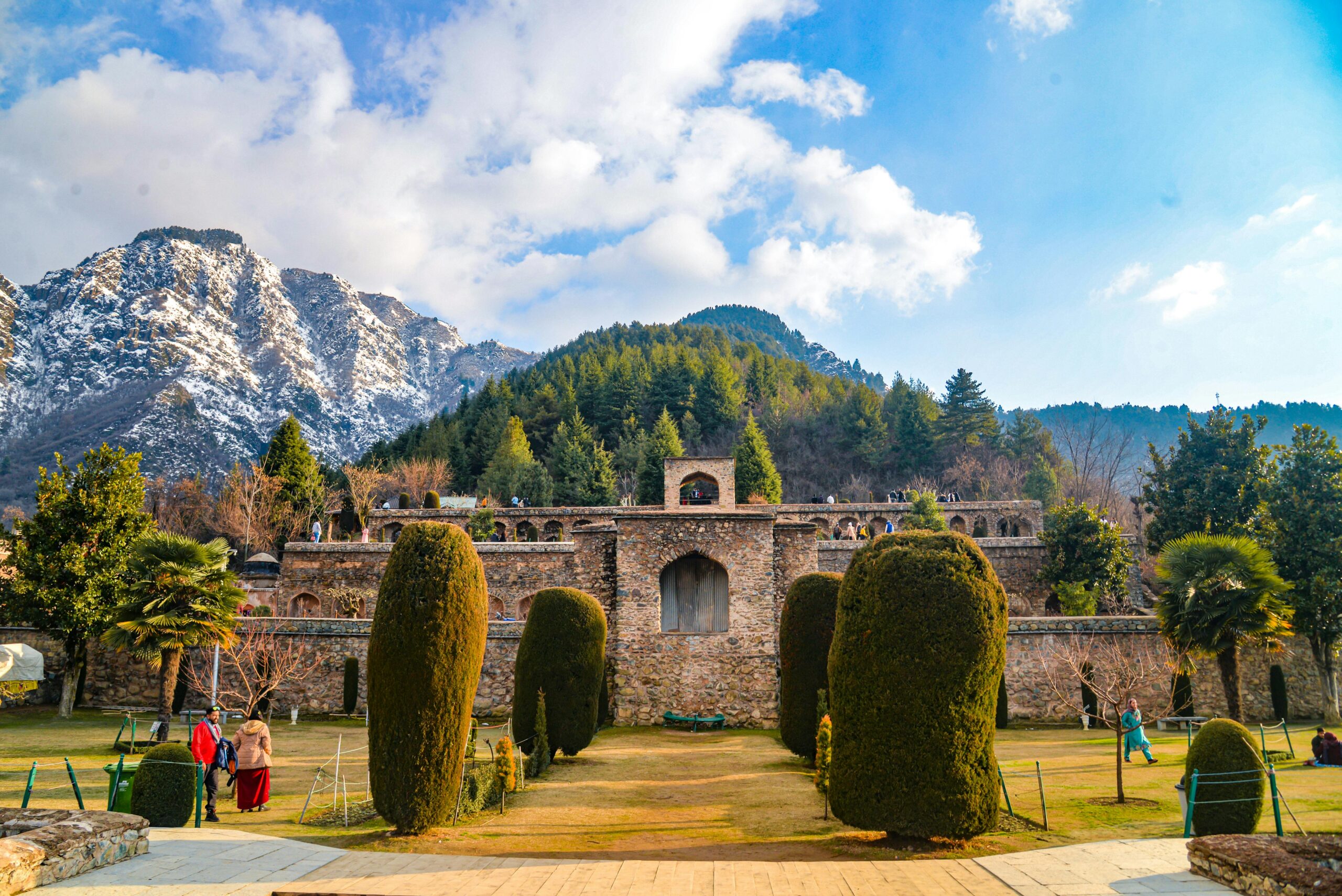
Walk in from the bottom entrance and the terraces rise in front of you. Twelve of them. They step up from Dal Lake toward the Zabarwan foothills. The layout runs east to west, about 548 metres long and 338 metres wide. Persian in concept and Kashmiri in execution.
Water comes from the top, not the centre. The hillside made a centre-fed design impossible, so the engineers ran the source from the highest terrace downward. The water feeds each cascade in sequence, moving terrace by terrace toward the lake. A clean solution. Still running after 400 years. Each terrace has a raised embankment separating it from the next. Chinar and cypress trees line the edges. Deep shade in summer. Full fire of colour in October. The second terrace is the one to stop at. It has 23 arched niches carved into the recess behind the main cascade. Oil lamps burned there at night, and the water would glow orange. Today the niches are empty, but the cascade still runs. The craft of that terrace is the most detailed of the twelve. Do not walk past it.
What to look for on your way up:
- Second terrace: 23 lamp niches sit behind the cascade. Stand here and look down toward the lake.
- Upper terraces (9th to 11th): the view opens fully. Dal Lake, houseboats, the distant Pir Panjal range. This is the frame the garden was built to create.
- Zenana section (top terrace): the private garden for the women of the household. Quieter. Most people skip it. Worth ten minutes.
- Marble thrones: stone seats at the head of the waterfalls throughout the garden, easy to walk past. Worth spotting.
Nishat Bagh is one of several Mughal gardens in Kashmir worth understanding as a group. Knowing how they relate to each other changes how you read each one.
Best Time to Visit Nishat Bagh
Autumn is the honest answer for most people. September to November brings the chinar trees into full colour. Orange, gold, deep red. The crowds thin out compared to the May rush. The air is cool. Late afternoon light in October falls soft on the terraces. That is the month we recommend when people ask us.
Spring in Kashmir (late March to early May) is another strong window. The garden blooms fully in this stretch. Roses, lilies, the whole flower calendar at once. The nearby Tulip Garden peaks around April. That makes the eastern Dal Lake stretch a garden circuit worth doing back to back. If flowers are your reason for coming, this is your window.
Summer (June to August) is the busiest period. Families and school groups fill the lower terraces by mid-morning. The sun on open terraces is harsh by 11 AM. Sounds like an exaggeration? It is not. If summer is your only option, come before 9:30 AM or after 4 PM when the heat eases. Midday visits in June are not worth it.
Winter (December to February) is quiet and cold. The fountains may not run. Flowers are gone. But snow-covered terraces with the frozen lake in the background make for pictures that summer cannot match. Come if you are already in Srinagar. Do not plan a trip just for this.
As of 2025 and 2026, October remains the sweet spot for most Indian visitors to Kashmir. Book your Srinagar hotel well ahead if targeting this window. It fills fast.
Season | Best for | Honest note |
Spring (Mar to May) | Flowers, full bloom | Peak crowds, higher hotel rates |
Summer (Jun to Aug) | Cool escape from plains heat | Harsh midday sun, school groups |
Autumn (Sep to Nov) | Chinar colour, calm weather | Late November can be overcast |
Winter (Dec to Feb) | Snow views, no crowds | Fountains may be off, very cold |
Nishat Bagh vs Shalimar Bagh: Which One to Visit
Both are Mughal gardens on Dal Lake. That is where the similarity ends. The inner feel of each garden is different enough that the choice matters. Especially if your time in Srinagar is short.
Nishat Bagh gives you the view. Stand on the upper terraces with Dal Lake below and the mountains at your back. That is the Kashmir postcard moment. The garden rises. It opens as you climb. The terraces build toward a reveal. First-time visitors to Kashmir respond to this garden most strongly, and for good reason.
Shalimar Bagh gives you the pavilion craft. It has four terraces instead of twelve, but the Mughal buildings inside are more detailed. Black marble columns. Ornate arches. More formal and more horizontal. Shalimar focuses on the structure. The view is secondary.
The call is simple. First time in Srinagar? Go to Nishat first. Coming back for a second Kashmir trip? Shalimar Bagh rewards the return visit more.
Nishat Bagh Timings and Entry Fee
The gate opens at 9 AM. That part is consistent and the closing time is 7 PM from April to October. In winter (November to March), the garden likely closes at 5 PM. Verify this at the gate before planning an evening visit in the off-season.
For entry fees, sources do not all agree. The most cited current figure for Indian nationals is INR 30 per person. We recommend carrying cash and checking the rate at the ticket counter. Fees can shift seasonally. Do not rely on older figures you find online.
Detail | Information |
Opens daily | 9:00 AM |
Closes (April to October) | 7:00 PM |
Closes (November to March) | Around 5:00 PM, verify at gate |
Entry fee, Indian nationals | Around INR 30, confirm at counter |
Open on holidays | Yes, all 7 days |
Personal photography is allowed inside. Tripods may be restricted on busy days. Drones need prior permission and are often refused on arrival. Do not assume clearance.
How to Reach Nishat Bagh Srinagar
Getting there is easy. Getting back is where most guides go quiet. Here is both. Nishat Bagh Srinagar sits on the eastern shore of Dal Lake, about 10 km from Dal Gate. The drive from Lal Chowk or the main Dal Lake hotels takes 25 to 30 minutes. The garden sits roughly 2 km past Shalimar Bagh on the Boulevard Road circuit.
Three options for getting there:
- Private taxi for the day:Rs. 1,500 to 2,000 covers a full Srinagar circuit. Nishat Bagh, Shalimar Bagh, Pari Mahal, Chashme Shahi. The driver waits at each stop. This is the option we recommend. Clean and straightforward.
- Shared cab: Flag one on Boulevard Road from Dal Gate. Easy going. The return is trickier. After your visit, step out and stand on the main road. Flag a cab toward Dal Gate or Lal Chowk. From there, find your hotel area on your own. Add 30 to 45 minutes for this.
- Own vehicle or rental bike: Straightforward. The road along the eastern lake shore is well-marked.
What to Do at Nishat Bagh: Beyond Just Walking Through
Most people walk in, look at the flowers on the first two terraces, take a few photos, and leave. They miss the whole point. The garden pays off for people who climb. Do not stop at the lower terraces. They are well-kept and photogenic, but the view has not opened yet. Keep going. The real frame starts around the 8th terrace. By the 10th, you are looking out over Dal Lake. The full length of the garden falls away below you. The Zabarwan Mountains stand at your back.
Outside the main entrance, the Nishat Ghat offers private shikara rides on Dal Lake. A typical ride runs 45 to 60 minutes. Fix the route and price before you step in. This is a good add-on if you want to combine a garden walk with time on the water. Start with the garden, then take the shikara after. The light on Dal Lake in the late afternoon is better than the morning.
For photos, arrive before 10 AM or after 4 PM. The terraces face west toward the lake. Late afternoon light falls directly on the water. Morning light is crisp and less busy. Avoid midday from May to August.
Places to Visit Near Nishat Garden Srinagar
Nishat Bagh is not a standalone stop. It sits at the start of a natural half-day circuit. Four of Srinagar’s best-known sites in one sweep, if you plan the routing right. The routing matters. Start at Nishat, which sits at the lowest point of the eastern lake road. Then drive 2 km to Shalimar Bagh. From there, head 3 km uphill to Chashme Shahi. It is the smallest of the three Mughal gardens, and the one with a natural spring. Just above it is Pari Mahal, a hilltop complex with the strongest panoramic views in Srinagar. Do the circuit bottom to top. No doubling back.
- Shalimar Bagh: 2 km from Nishat. Formal Mughal garden with pavilion craft. Allow 45 to 60 minutes.
- Chashme Shahi: 5 km from Nishat. Smallest of the three gardens. Famous for spring water. Worth 20 to 30 minutes.
- Pari Mahal: Just above Chashme Shahi. Hilltop ruins with strong sunset views over Dal Lake. Allow 30 to 40 minutes.
- Dal Lake shikara ride: From Nishat Ghat or the main Dal Gate area. Best in late afternoon.
- Hazratbal Mosque: 6 km from Nishat on the northern shore. A key religious and cultural site if your day allows the detour.
Visitor Tips for Nishat Bagh
The most useful tip most guides bury is this: food is not allowed inside the garden. Vendors and small shops sit right outside the main gate. Eat before you go in or after you come out. The garden does have clean pay-and-use toilets inside. Small relief.
A few more things worth knowing:
- Arrive before 10 AM on weekdays or after 4 PM on any day to miss the peak crowd pressure on the lower terraces.
- Wear shoes with grip. The stone pathways between terraces get slippery when water runs over them.
- Carry cash for entry. No guarantee of a card reader at the counter.
- Lower terraces are shaded. Upper terraces are open. In summer, bring a hat or go up early.
- Tripods and professional rigs may be asked to be put away on busy days. Stay flexible.
- The garden stays open on all national holidays. Long weekends in May or October mean bigger crowds from 11 AM onward. Plan accordingly.
Conclusion
The difference between a good visit to Nishat Bagh and a forgettable one is timing. Go in the evening in autumn. Climb to the upper terraces. Wait for the light to shift over the lake. That is the version of Nishat Bagh people come back talking about. You enjoy the terraces.
Still building your Srinagar plan? The full Kashmir itinerary guide helps you sequence Nishat, Shalimar, and the rest of the valley without wasted days.